World Environment Day, Contribution of the Forestry Program at Unismuh: Maintaining Forests, Securing the Future
UNISMUH.AC.ID, MAKASSAR
- In the face of deforestation, land degradation, climate change, and pressure on forest areas, the Forestry Study Program at Universitas Muhammadiyah (Unismuh) Makassar is strengthening its contribution through education, research, land rehabilitation, coffee agroforestry, and the development of an educational forest as a natural laboratory.World Environment Day is not just an annual celebration. For the Forestry Study Program at Unismuh Makassar, June 5th is a reminder that environmental sustainability requires long-term effort, collaboration, and a focus on the future.
Indonesia is known for its rich natural resources and high biodiversity. However, this wealth comes with ecological challenges. Deforestation, land degradation, land use changes, environmental pollution, and the impacts of climate change are issues that require collective attention.
Ir. Jauhar Mukti, S.Hut., M.Hut., IPM., Head of the Forestry Department at the Faculty of Agriculture, Unismuh Makassar, believes that World Environment Day should be seen as an opportunity to strengthen collective awareness.
"Environmental sustainability is a shared responsibility. It requires the collaboration of government, education, business, and society to protect the Earth for future generations," he said.
In South Sulawesi, environmental issues manifest in various forms. Decreasing forest cover in upstream areas, increasing flood and landslide risks, fires during the dry season, and pressure on forest areas due to development activities are challenges that require serious attention.
In the face of these challenges, the Unismuh Makassar Forestry Study Program is trying to play a role through three main pathways of higher education: education, research, and community service.
Educational Forest as a Natural Laboratory
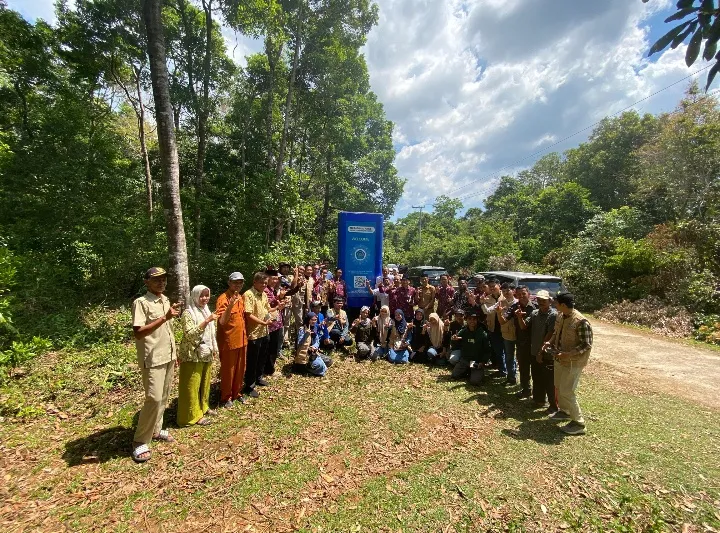
One of the important contributions of the Unismuh Makassar Forestry Study Program is the development of the Unismuh Makassar Educational Forest. This area is designed as a center for education, research, conservation, and community empowerment.
The location of the Unismuh Educational Forest is on the edge of the road, specifically in Pacekke Village, Soppeng Riaja Subdistrict, Barru Regency, with an area of approximately 229 hectares.
For Unismuh, the Educational Forest is not just a place for student practice. Furthermore, this area is being developed as a natural laboratory that allows students and lecturers to directly study the dynamics of forest ecosystems, land rehabilitation, agroforestry, biodiversity conservation, and community empowerment around the forest area.
Jauhar explained that the development of the Unismuh Makassar Educational Forest is currently focused on coffee agroforestry. This model integrates ecological, social, and economic interests. On the one hand, the forest is maintained through sustainable management practices. On the other hand, the community can obtain economic benefits from the commodities developed.
"Through this development, we hope that the Unismuh Makassar Educational Forest can provide sustainable economic, social, and environmental benefits, so that the dream of 'Sustainable Forest, Prosperous Community' can be realized," said Jauhar.
This concept is important because forest preservation cannot be separated from the well-being of the community. A sustainable forest requires community support. Conversely, a prosperous community has more space to maintain the forest sustainably.
Agroforestry and Empowerment
Coffee agroforestry is one of the key focuses of the Unismuh Makassar Forestry Study Program. Through this approach, forest and economically valuable plants can be developed in a single management system that supports each other.
For the Forestry Study Program, agroforestry is not just a planting pattern. It is a space to learn how conservation, production, and community empowerment can work together. Students can learn about forest inventory, silviculture, forest and land rehabilitation, mapping, and the social-economic interactions of communities around the forest area.
Jauhar Mukti's experience in forest and land rehabilitation, agroforestry planning, social forestry, and forest enterprise support further strengthens this direction. As an academic and forestry practitioner, he sees the importance of an approach that is not only ecological but also social and economic.
In the context of South Sulawesi, this approach is relevant. Many upstream areas require land cover restoration, but at the same time, the community also needs sources of income. Agroforestry provides a way to bridge these two needs.
Conservation, Rehabilitation, and Climate Change
Climate change has a significant impact on the forestry sector. Changes in rainfall patterns, increased temperatures, and extreme weather can affect the growth of forest plants, increase the risk of forest and land fires, and disrupt ecosystem balance.
However, forests also play a role in the solution. Forests help absorb carbon, regulate water, protect soil from erosion, provide oxygen, provide habitat for biodiversity, and provide economic benefits to communities.
Therefore, the Unismuh Makassar Forestry Study Program encourages various programs related to environmental conservation and rehabilitation. These programs include land rehabilitation, tree planting, environmental education, and support for forest-based community enterprises to promote sustainable management.
In terms of research, the lecturers and students of the Unismuh Makassar Forestry Study Program have developed studies related to sustainable coffee agroforestry management, forest and land rehabilitation, canopy and carbon storage, adaptation and mitigation of agroforestry systems to climate change, community participation in forest management, and sustainable agroforestry-based business models in forest education areas.
These studies show that forestry issues are no longer just about trees and forest areas. Forestry is directly related to climate change, ecological disasters, economic conditions of communities, spatial planning, and future development.
Students as Agents of Change
In the environmental conservation movement, forestry students have a strategic role. They not only learn in the classroom, but also go out into the field through conservation, land rehabilitation, research, environmental campaigns, and community empowerment.
According to Jauhar, forestry students are agents of change. Through field practice, they gain academic experience and contribute directly to environmental conservation.
This educational model is one of the strengths of the Unismuh Makassar Forestry Study Program. Learning is not only focused on theory, but also on practical experience in the field. Students are trained to understand the forest as an ecosystem, a source of life, and a social space where communities depend on it.
From Forest Products to Forest Bathing
In the future, the development of the Unismuh Makassar Educational Forest will not only focus on coffee agroforestry. The Forestry Study Program will also open up opportunities for developing non-timber forest products, ecotourism, and forest bathing.
The concept of forest bathing is to use forests as an educational, recreational, and health space based on nature. In the global context, forests are not only seen as providers of wood or conservation areas, but also as spaces for human physical and mental recovery.
This approach shows that the environmental benefits of forests are vast. Forests can provide ecological, economic, social, educational, and even health benefits. Therefore, forest preservation is not only important for the environment, but also for human quality of life.
For Unismuh Makassar, this development is in line with the campus's sustainable spirit. The Forestry Study Program aims to bring together knowledge, community needs, and environmental sustainability.
Value-Based Forestry Education
The Forestry Study Program at Unismuh Makassar, under the Faculty of Agriculture, is committed to producing outstanding, professional, and Islamic-oriented human resources in the field of forestry.
The program's vision is to become a leading program in forestry science and technology, and to produce high-quality human resources in managing forests based on society and with Islamic values.
This vision is translated through education, research, community service, and Islamic values guidance. Therefore, forestry education at Unismuh is not only focused on learning and skills, but also on character development and moral responsibility towards the environment.
In the context of the ecological crisis, value-based education is important. Environmental problems are not only caused by a lack of technology, but also by human perceptions of nature. Therefore, forestry students must be equipped with ethics, care, and courage to act in favor of sustainability.
Message to the Youth
World Environment Day 2026 is an opportunity for the Unismuh Makassar Forestry Study Program to invite young people to play a bigger role. The future of the environment is not only determined by today's policies, but also by the awareness of future generations who will lead the future.
Jauhar urges young people to be pioneers in change towards a greener and more sustainable future. Concern for the environment must start with oneself, then expand through knowledge, technology, and concrete actions.
Simple steps are important. Reducing the use of single-use plastics, planting and caring for trees, saving energy and water, sorting waste, supporting eco-friendly products, and keeping the surrounding environment clean are small actions that can have a significant impact if done consistently and together.
In the face of climate change and increasing pressure on the environment, the Unismuh Makassar Forestry Study Program's contribution shows that higher education has an important role. Campuses are not just places to produce graduates, but also places to care for the earth, rehabilitate land, strengthen communities, and build a more sustainable future.
From the Educational Forest, coffee agroforestry, carbon research, land rehabilitation, to community empowerment, the Unismuh Makassar Forestry Study Program reaffirms a simple but fundamental message: preserving the forest means preserving life.
Ultimately, World Environment Day is not just a celebration. It is a call to action. For the Unismuh Makassar Forestry Study Program, this call is answered through education, research, and service that are based on a simple but fundamental dream: a sustainable forest, a prosperous community.
Sustainable Development Goals
Related News
BEM FISIP Unismuh Makassar Gelar Medical Check-Up Bersama BEM Fakultas Kedokteran
30 Jun 2026
Himagri Unismuh Makassar Padukan Expo Bisnis dan Tadabbur Alam
29 Jun 2026
Mahasiswi MPBI Unismuh Bangun Literasi Lewat Jurnalisme Sekolah di Thailand
26 Jun 2026